Research and evidence
A collection of research focusing on the most prominent subjects relating to young onset dementia, gathered by members of the Young Dementia Network Steering Group and other experienced researchers.
By Maud Ritzen
Alzheimer Centrum Limburg, Maastrict University
Dementia is often associated with old age, but for individuals diagnosed before the age of 65, the experience presents a distinct set of challenges. Young onset dementia affects people who are often still active in their professional, social, and family lives. As such, the impact of young onset dementia can extend beyond the individual and affect partners, children, and broader support networks.
To better understand the specific needs of people with young onset dementia and family carers, we conducted a scoping review entitled “Needs of people living with young-onset dementia and family carers, specified by subtype, phase in the disease process and living setting.” This scoping review includes 140 articles and offers an extensive overview of the literature in relation to the need of families affected by young onset dementia. The publication highlights how needs might differ depending on the dementia subtype, phase in the disease process, and living situation of the person with young onset dementia.

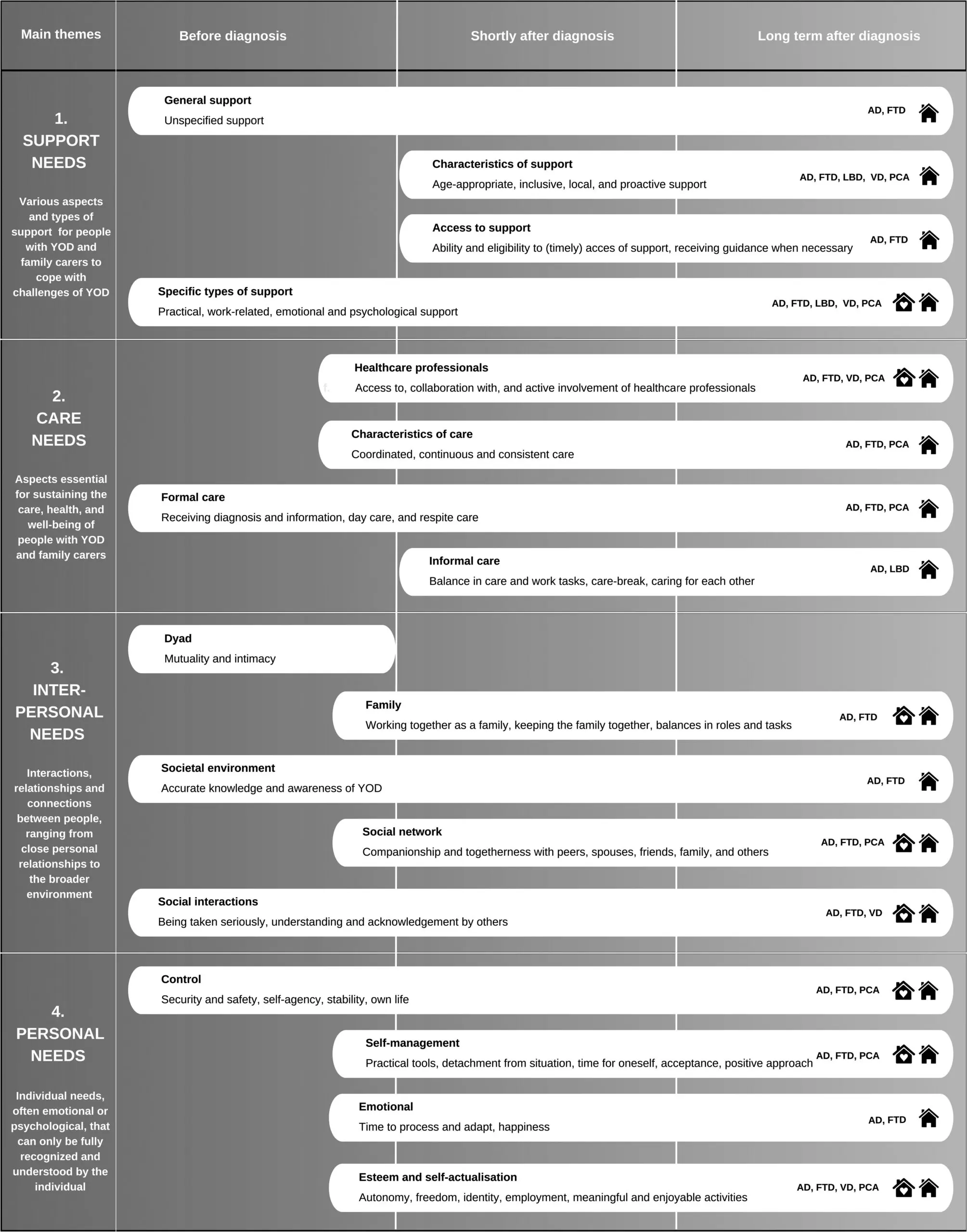
Across the included studies, the authors identified four overarching categories of needs:
Support needs
Emotional and practical assistance, including psychological support, practical support, work-related support, and support with navigation through complex care systems.
Care needs
Reliable information about diagnosis, prognosis, and treatment options, along with consistent professional guidance and coordination of services.
Interpersonal needs
A desire for understanding, empathy, and social connection within families and from the wider community.
Personal needs
The need to maintain identity, autonomy, and a sense of purpose, as well as personal time and security, particularly for family carers.
Specified information of these four categories of needs in relation to dementia subtype, phase in the disease process, and living setting can be found in Figure 1.
What stands out is the strong emphasis on interpersonal and psychosocial dimensions. People living with young onset dementia and their relatives often describe a lack of understanding from their social environment, as dementia is still perceived largely as a condition of old age. This misunderstanding can lead to isolation and emotional strain, underlining the importance of support that extends beyond medical care alone.
Several dementia subtypes share overlapping needs. Needs specifically related to frontotemporal dementia (FTD) and posterior cortical atrophy (PCA) include support with speech and language, such as speech therapy. In addition, there is an overarching need in multiple subtypes for subtype-specific information.
Needs specified by phase in the disease process
Before diagnosis, there is a strong need for receiving an accurate diagnosis in a timely manner. Shortly after diagnosis, people express the need for quick access to appropriate practical, emotional, psychological, and work-related support and information. In the longer term, these needs shift towards continuity of care, meaningful daily activities, and finding a balance between personal time and caregiving responsibilities for family members.
Needs specified by living situation
In the home setting, young people with dementia emphasize the need for work related and practical support, meaningful daytime activities, and collaboration within the family. For family members, maintaining a good balance between caregiving responsibilities and time for themselves is particularly important. In care facilities, the main needs relate to trust in care professionals, safety, and opportunities for contact with peers of a similar age.
Diversity in young onset dementia
A key conclusion from the review is that there is no single or uniform experience of young onset dementia. The needs of people living with Alzheimer’s disease may differ from those of individuals with frontotemporal dementia or other, rarer subtypes. Similarly, the challenges faced early in the diagnostic process are often not the same as those encountered later, when care becomes more complex or residential care is required.
From research to practice
Standardised approaches to dementia care, often developed with older populations in mind, may not adequately address the realities of younger people and their families. Instead, services should be flexible, individualised, and responsive to the specific context of each family, considering the dementia subtype, living setting, and phase of the illness.
For professionals, this means listening actively to what families express as their most pressing needs. For researchers, it highlights the importance of diversifying study samples to include underrepresented groups (rarer forms of young onset dementia and persons with young onset dementia living in care homes). For society more broadly, it reinforces the need to reduce stigma and promote understanding of young onset dementia as a distinct and significant public health concern.
November 2025
A collection of research focusing on the most prominent subjects relating to young onset dementia, gathered by members of the Young Dementia Network Steering Group and other experienced researchers.
An introductory guide to help you find and understand research on young onset dementia.
Do you know of a young onset dementia research study for inclusion in our collection?